Strip Malls and Retail Centers at Tax Deed Auctions: Anchor Tenant Leases, Deferred Maintenance, and the Risks Every Investor Must Evaluate Before Bidding
Strip malls and small retail centers appear regularly at tax deed auctions, and their price tags can look attractive compared to conventional commercial transactions. But behind every distressed storefront lies a web of surviving leases, deferred maintenance obligations, zoning requirements, and lender entanglements that can easily exceed your purchase price. Evaluating every risk layer before you bid is not optional—it is the entire job.
Why Retail Properties End Up at Tax Deed Auctions
Retail commercial properties fall into tax delinquency for a narrower set of reasons than residential homes, and understanding those reasons tells you a great deal about what you are inheriting. The most common scenario involves an owner whose anchor tenant vacated, leaving insufficient rental income to cover property taxes, mortgage payments, and ongoing maintenance simultaneously. In some cases the entity that owns the property—often an LLC or limited partnership—simply dissolved, leaving no responsible party to manage obligations.
Another pattern involves properties caught in estate disputes or partnership dissolutions where multiple parties each assumed the other was paying the taxes. By the time the county initiates foreclosure, several years of delinquency may have accumulated, and the physical plant has suffered from deferred maintenance. Every dollar of back taxes you pay at auction is money spent before you have assessed whether the building is structurally sound, code-compliant, or legally encumbered by tenants you did not know existed.
- Anchor tenant departure leading to cash-flow collapse
- LLC or entity dissolution with no active manager
- Partnership disputes that paralyze financial obligations
- Estate ownership where no heir monitors tax payments
Surviving Leases: The Hidden Landlord Obligations You Inherit
One of the most consequential and underappreciated risks in retail tax deed investing is the possibility that existing leases survive your deed. In most jurisdictions, a tax deed extinguishes junior liens, but leases are not technically liens—they are contractual possessory interests, and courts across the country have reached different conclusions about whether a tax deed terminates them. If a tenant signed a long-term lease before the tax delinquency began, and if that tenant's lease pre-dates the tax lien, you may step into the role of landlord bound by every term the prior owner agreed to.
That means you could be obligated to maintain common areas, provide utilities, honor below-market rent locked in years ago, or fund tenant improvement allowances the prior owner promised. Some leases include co-tenancy clauses that allow a remaining tenant to reduce rent or even terminate if a named anchor leaves—meaning your income stream could drop the moment you take title. Before bidding on any retail property, obtain a copy of every lease on record, review each for term length, renewal options, assignment rights, and any landlord obligations that travel with the property.
If leases cannot be obtained before the auction—which is common—treat the property as though it carries the worst-case lease scenario. Price that risk into your maximum bid, because discovering an unfavorable ten-year lease after the gavel falls is a problem you cannot undo.
- Co-tenancy clauses that reduce rent when anchor space is vacant
- Below-market rent locked in by long-term leases predating the lien
- Landlord improvement allowance obligations embedded in lease terms
- Renewal options that prevent you from repositioning or redeveloping
- Assignment and subletting restrictions that limit your exit strategies
Anchor Tenant and REA Agreements: Encumbrances That Run With the Land
Many retail centers were originally developed under a Reciprocal Easement Agreement, or REA, negotiated between the developer and an anchor tenant such as a grocery chain, pharmacy, or big-box retailer. REAs are recorded documents that create cross-easements for parking, shared access drives, common area maintenance cost-sharing obligations, and sometimes restrictions on what competing uses may operate within the center. Because REAs are recorded encumbrances, they typically survive a tax deed sale just as easements do.
This means you could acquire a property where a departed anchor retains recorded rights to a portion of the parking field, where you are contractually obligated to maintain a shared driveway at your expense, or where a use restriction prevents you from leasing to a tenant whose business competes with a former anchor that no longer even occupies the center. These provisions are not hypothetical edge cases—they appear routinely in properties built during the suburban retail boom, and they are often overlooked by investors doing only a superficial title review.
Always pull the full chain of title and search for recorded REAs, operating agreements, and declaration of covenants before bidding. Your title search should go back far enough to capture instruments recorded at the time the shopping center was originally developed, not just instruments recorded in the last few years.
- Recorded REAs that survive the tax deed and bind new owners
- Parking easements in favor of former tenants who no longer occupy space
- Use restrictions that limit viable tenant categories
- Shared maintenance cost-sharing obligations with adjacent parcel owners
Code Violations, ADA Compliance, and Deferred Maintenance
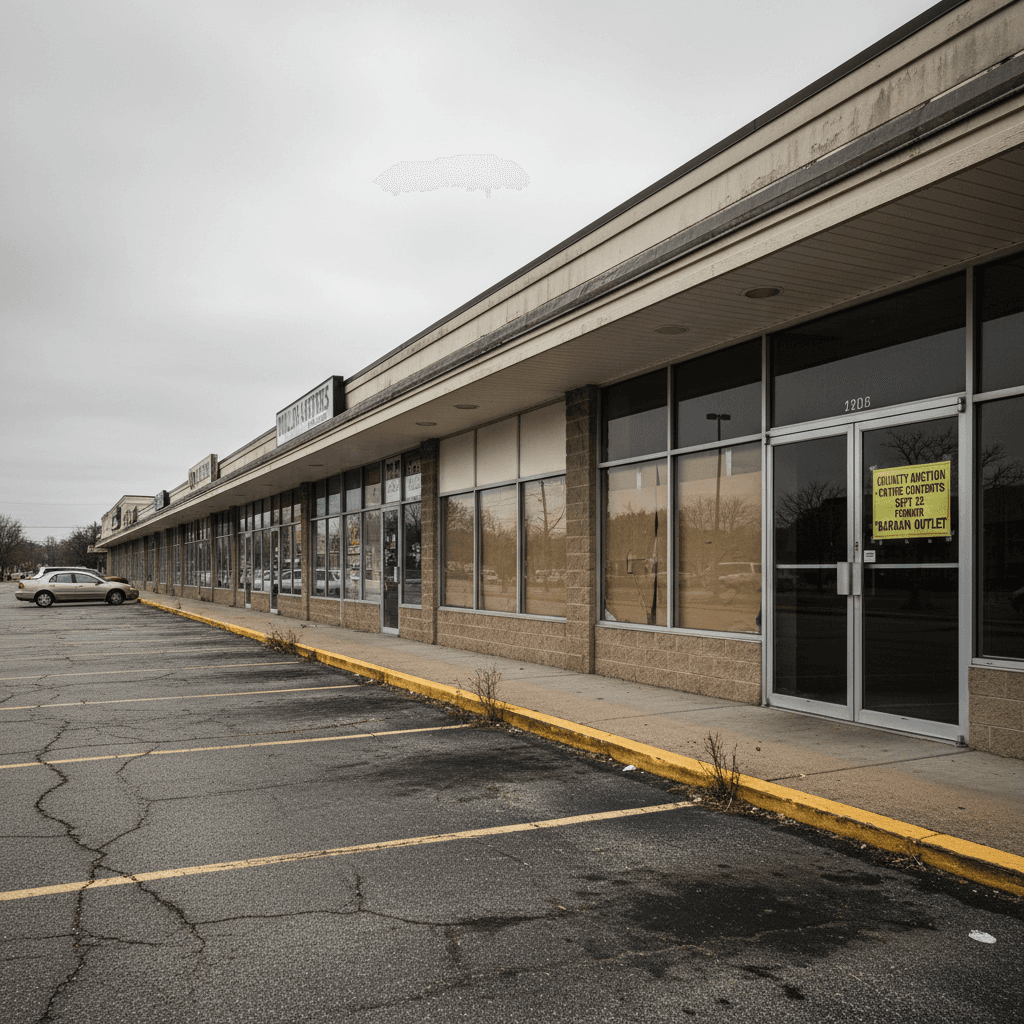
Retail properties that have gone through years of ownership instability almost always carry a backlog of deferred maintenance and unresolved municipal code violations. Parking lot surface deterioration, roof failures, HVAC systems that have not been serviced, plumbing deficiencies, and electrical panels that do not meet current code are common in distressed retail centers. Because tax deed buyers typically cannot inspect the interior before bidding, these conditions are invisible at the point of purchase.
The Americans with Disabilities Act adds a layer of exposure specific to commercial properties. When a new owner undertakes renovations or even certain repairs, ADA compliance upgrades can be triggered—covering accessible parking ratios, entrance ramp grades, restroom configurations, and path-of-travel requirements from parking to the entrance. These upgrades can be expensive, and they are not optional. A buyer who budgets only for cosmetic improvements and ignores accessibility compliance may face stop-work orders or complaints that delay any revenue-generating use.
Municipal code violations are particularly dangerous in retail contexts because many jurisdictions have the authority to place a lien on the property for unpaid civil fines, and depending on when those fines accrued and how state law treats them, they may survive the tax deed sale. Check with the local code enforcement office and building department before bidding—not just the tax collector's office.
- Roof, HVAC, and structural deferred maintenance invisible before the auction
- ADA path-of-travel and parking compliance triggered by post-purchase work
- Outstanding code violation liens that may survive the deed
- Sprinkler and life-safety system deficiencies requiring costly remediation
Zoning, Nonconforming Use, and Repositioning Risk
Retail centers are often located in commercial zones, but the specific permitted uses within that zone, the required parking ratios, the signage allowances, and the setback requirements can vary enormously from municipality to municipality. A building that was legally operating under a prior owner's permitted use may not automatically allow you to bring in a new tenant with a different business category. In some jurisdictions, a change of use—even within a broad commercial zone—triggers a new site plan review, updated parking calculations, and potentially costly infrastructure improvements.
Nonconforming use status presents an additional trap. A structure built before current zoning regulations may be a legal nonconformity, meaning it can continue operating in its current configuration but cannot be substantially rebuilt if damaged beyond a threshold percentage of its assessed value. If you acquire a nonconforming retail building and a fire or storm causes major damage, you may find yourself unable to rebuild to the prior footprint under current zoning. This risk is not theoretical in markets where storm or deferred-maintenance damage is already evident.
Investors who plan to reposition a distressed retail center—converting it from retail to mixed-use, medical office, self-storage, or another category—should consult with a local land-use attorney and the municipal planning department before bidding. The feasibility of your exit strategy depends entirely on what the zoning will allow, and zoning determinations are not reversible by negotiation after you own the property.
- Change-of-use triggers requiring new site plan approval
- Parking ratio deficiencies that block new tenant categories
- Nonconforming structure status limiting rebuild rights after damage
- Conditional use permits that are personal to the prior owner and do not transfer
How to Evaluate Retail Tax Deed Properties Before You Bid
The due diligence sequence for a retail tax deed property is more complex than for a single-family home, and it needs to begin well before auction day. Start with a full title search that goes back to the original development of the center, specifically looking for REAs, reciprocal access agreements, recorded leases, and any subordination or non-disturbance agreements that may protect tenants. Then search the county recorder's office for any lis pendens, pending litigation, or bankruptcy filings associated with the prior owner—a bankruptcy trustee can sometimes challenge a tax deed if the debtor had equity in the property.
Drive the property at different times of day and document what you observe about occupancy, parking lot condition, signage, and any visible structural issues. Check the county assessor's records to identify the assessed value and compare it to auction price expectations. Contact code enforcement, the building department, and the fire marshal's office to request a history of complaints and violations. Verify whether any utilities have been disconnected, because reconnecting commercial-grade water, gas, or electrical service can require expensive upgrades to meet current code.
Finally, use a tool like TaxDeedIQ to surface risk factors associated with the property before you bid—encumbrances, lien layers, flood zone designation, and other data points that should inform your maximum bid calculation. No single source of information is sufficient on its own, but layering public record research with professional review and a technology platform designed for auction due diligence gives you the best possible picture of what you are actually buying.
- Full title search back to original development date
- REA and recorded lease review for surviving obligations
- Code enforcement and building department violation history
- Bankruptcy and lis pendens search on prior owner
- Utility status verification before auction day
- Flood zone and environmental hazard screening
Don't buy someone else's debt
See exactly what can survive a tax deed, before your money is on the block. Every auction, scored 0–100.
Score my first auction, freeStrip Malls and Retail Centers at Tax Deed Auctions FAQ
Do existing tenant leases survive a tax deed sale on a retail property?
It depends on state law and the specific facts of each lease. Leases are possessory interests rather than liens, and many courts have held that they are not automatically extinguished by a tax deed. If the lease predates the tax lien, the risk of survival is higher. Always obtain and review all recorded and unrecorded leases before bidding, and consult a real estate attorney in the state where the property is located.
What is a Reciprocal Easement Agreement and why does it matter at a tax deed auction?
A Reciprocal Easement Agreement is a recorded instrument, common in shopping centers, that creates cross-easements for parking, access, and shared maintenance between the center owner and one or more anchor tenants. Because it is a recorded encumbrance rather than a personal contract with the prior owner, it typically survives a tax deed sale and binds the new owner. You may inherit obligations to maintain shared driveways, parking areas, and common utilities even if the anchor tenant whose benefit the REA serves has long since vacated.
Can a code violation lien on a retail property survive a tax deed sale?
In many states, municipal code violation liens that were recorded before the tax lien may survive the tax deed sale as senior encumbrances. Even liens recorded after the tax lien can sometimes survive if the governing state statute gives them special priority. Before bidding on any retail property, contact the local code enforcement office and building department to obtain a full violation history and determine whether any outstanding fines have been converted to recorded liens.
What ADA obligations do I take on when I buy a retail strip mall at a tax deed auction?
When you become the property owner, federal ADA requirements apply to you as the new owner and operator of a place of public accommodation. If you undertake renovations or alterations, ADA path-of-travel requirements can obligate you to bring accessible routes, parking, and restrooms into compliance even if you are only renovating one tenant space. The scope and cost of these obligations should be factored into your pre-auction due diligence, especially for older retail buildings that were built before current accessibility standards.
How should I factor surviving lease risk into my maximum bid at a retail tax deed auction?
Model a worst-case scenario: assume every lease in the building survives, assume rent is at below-market rates, assume you are bound by every landlord obligation in those leases, and assume at least one co-tenancy clause reduces income further. Calculate the income stream under that scenario, apply a capitalization rate appropriate for distressed retail in that market, and subtract your estimated remediation and compliance costs. That number is your ceiling—bid below it to preserve a margin for the risks you could not quantify before the auction.
More guides
- Tax Deed vs Tax Lien: What's the Difference? (2026 Guide)
- Is Tax Deed Investing Safe? 6 Risks to Check Before You Bid
- Tax Deed Surplus Funds: How Overbid Recovery Works
- Redeemable Deed States Explained (Georgia, Texas & More)
- Nightclubs and Bars at Tax Deed Auctions: Liquor License Gaps, Code Violations, and the Risks Every Investor Must Evaluate Before Bidding
- nope
Informational only, not legal or investment advice. Confirm rules with the county and consult a licensed professional before bidding.