How to Buy Tax Liens in Washington State: Distraint Warrants, 12% Interest, and the Risks Investors Must Evaluate First
Washington State runs one of the most misunderstood tax sale systems in the country — a hybrid process that blends lien-like certificates with a direct path to foreclosure that moves faster than many investors expect. The 12% annual interest rate sounds modest compared to some states, but the mechanics of how counties handle delinquent taxes here create real profit opportunities alongside risks that can erase an inexperienced bidder's margin entirely. Before you bid at any Washington county treasurer auction, you need to understand exactly what you are buying, what survives the sale, and what the redemption timeline actually looks like on the ground.
- State
- WA
- Sale
- Tax deed
- Redemption
- —
- Rate
- —
No redemption period after the sale, which does not clear the liens that survive.
See all 50 state rules →How Washington State Handles Delinquent Property Taxes
Washington is generally classified as a tax deed state, but the path from delinquency to deed is not a single clean step. When a property owner fails to pay property taxes, the county treasurer records a certificate of delinquency against the parcel. That certificate earns interest at a statutory rate set by state law, and once the delinquency ages past a certain threshold the treasurer can initiate a tax foreclosure action through the county superior court. The result of a successful foreclosure is a treasurer's deed conveying the property to the county, which then offers it at a public auction.
Unlike pure tax lien states — where an investor buys a certificate and waits for the owner to redeem or forecloses independently — Washington counties hold the foreclosed deed themselves and then sell the property at auction. Investors in Washington are therefore buying real property at auction, not a lien certificate. That distinction matters enormously for due diligence, because you are evaluating a physical asset and its encumbrances, not just the priority of a financial instrument.
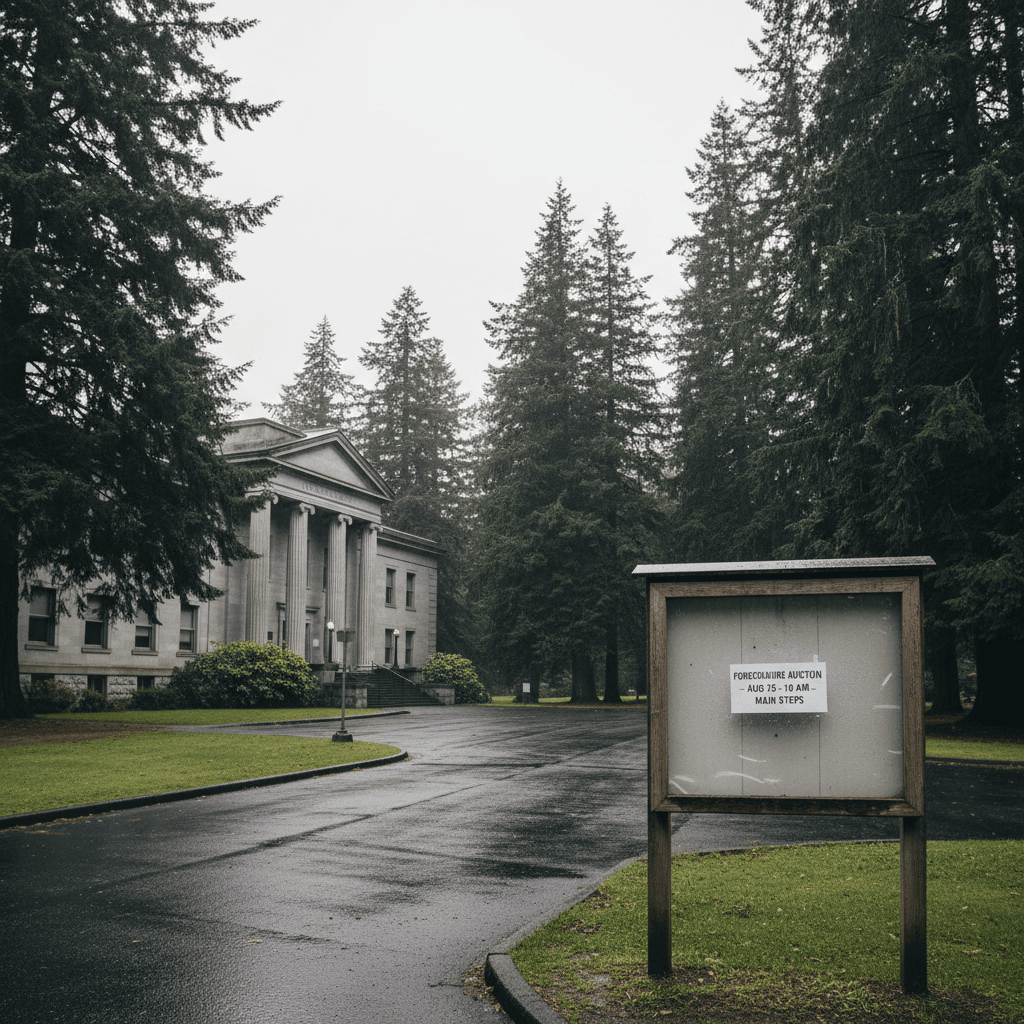
Each of the 39 counties administers its own process under the common framework of RCW Title 84. Auction dates, minimum bid policies, and the specific parcels offered vary by county and by year. Larger counties like King, Pierce, and Snohomish may hold online auctions through third-party platforms, while smaller rural counties may conduct in-person sales at the courthouse. Confirming the current process with the specific county treasurer's office before you plan any bids is essential.
- Certificate of delinquency recorded by county treasurer after taxes go unpaid
- Foreclosure filed in county superior court after the statutory delinquency period
- County takes treasurer's deed on successful foreclosure
- County then auctions the property publicly — investors buy real property, not certificates
- 39 counties each administer their own sale calendar and procedures under RCW Title 84
Interest Rates, Penalties, and What You Actually Earn
Washington's statutory interest rate on delinquent property taxes is set by state law and has historically been in the range of 12% per year, though investors should always verify the current rate with the county treasurer or a licensed professional rather than relying on any published figure that may be outdated. The interest accrues on the delinquent tax balance, not on your bid price at auction — an important distinction that shapes how you should think about returns.
Because Washington conducts property auctions rather than certificate sales, investors do not receive a direct interest yield the way they would in a pure lien state like Arizona or Iowa. Instead, the return model in Washington is an equity spread: you bid at auction, the county sets a minimum bid that typically covers back taxes, fees, and costs, and your profit potential depends on how much the property is worth relative to what you pay. A 12% statutory rate is relevant context for understanding how much a redeeming owner might owe the county during the process, but once the property reaches public auction the redemption window has typically closed.
This means Washington tax deed bidders must think like real estate investors, not like certificate holders. Your analysis should center on after-repair value, comparable sales, carrying costs, title risks, and resale or rental potential — not on a fixed interest coupon.
The Redemption Window and What Closes It
One of the most critical timeline questions in any tax sale state is: when does the owner lose the right to redeem? In Washington, property owners have a period to redeem their taxes after the certificate of delinquency is recorded but before the foreclosure is completed and the treasurer's deed is issued. Once the court confirms the foreclosure and the deed transfers to the county, the prior owner's redemption right is extinguished.
However, the process is not instantaneous. From the initial delinquency notice through court foreclosure proceedings, the timeline can span multiple years depending on county backlog, legal challenges, and whether the owner contests the action. Investors purchasing at a county's public auction are buying after that window has closed — the deed in the county's hands has already passed through the foreclosure judgment.
What this means practically: by the time you bid, you generally do not face a post-sale redemption period in the way Iowa or Maryland lien buyers do. But you do face the possibility of title clouds, surviving liens, and unresolved legal questions that can make the deed harder to convey to a future buyer or to insure. Do not confuse 'no post-auction redemption' with 'clean title.'
- Owners may redeem any time before the treasurer's deed is issued to the county
- Once the county holds the deed and lists the property for auction, redemption is closed
- No post-auction redemption period for the buyer — but title issues can still exist
- Contested foreclosures can delay the process and complicate the chain of title
Liens and Encumbrances That Can Survive the Deed
This is where Washington tax deed buyers absorb the most unexpected losses. A common misconception is that a tax foreclosure wipes the property clean of all prior encumbrances. In Washington, as in most states, that is only partially true — and the exceptions can be expensive.
Federal tax liens held by the IRS do not automatically extinguish in a state tax foreclosure. The IRS has a statutory right of redemption that lasts for a defined period after the sale, meaning the federal government could step in and reclaim the property. Investors must search for recorded federal tax liens before bidding and factor the IRS redemption right into their risk analysis. The IRS 120-day redemption right is a nationally applicable rule that every tax deed buyer should understand regardless of state.
Special assessments levied by municipalities or special districts — for sidewalks, street improvements, sewer connections, and similar infrastructure — may survive the tax foreclosure depending on how they are structured under state and local law. Utility liens, code enforcement liens, and environmental cleanup orders can also follow the property. In some cases, junior mortgage liens are wiped out by a superior tax foreclosure; in others, procedural defects in the foreclosure notice process can leave those liens intact and enforceable against a new owner. Washington's notice requirements for foreclosure are specific, and a foreclosure that did not properly serve all lienholders may be vulnerable to legal challenge.
A title search and, where possible, a title commitment from a licensed title company before you bid is not optional risk management — it is the foundation of your due diligence. Many Washington counties will not guarantee clear title, and some explicitly state they convey only whatever interest the county holds.
- IRS federal tax liens survive state foreclosure — 120-day redemption right applies
- Special assessments and municipal improvement liens may not be extinguished
- Utility arrears and code enforcement orders can follow the property to new owner
- Procedural defects in foreclosure notice can leave junior liens intact
- County typically conveys only quitclaim-style interest — no warranty of title
Environmental Risk and Physical Due Diligence
Washington's geography — ranging from dense urban cores in King County to rural timber land in the Olympic Peninsula and agricultural parcels in Eastern Washington — means that the physical condition and environmental status of a parcel varies enormously. Vacant land that appears at auction may be subject to wetland restrictions under state Shoreline Management Act rules, critical area ordinances administered by individual counties, or federal Clean Water Act jurisdiction. A parcel that looks like a buildable lot on a tax map may be legally unbuildable because of these restrictions, rendering it nearly worthless even if acquired for minimal back taxes.
Industrial or commercial properties carry the additional risk of contaminated soil or groundwater. Washington's Model Toxics Control Act imposes cleanup liability on property owners, including buyers at tax auction who had no role in creating the contamination. Before bidding on any former commercial, industrial, or agricultural parcel, researching the parcel in the Washington Department of Ecology's Integrated Site Information System is a prudent step.
Flood zone status should also be verified through FEMA's National Flood Insurance Program maps. Properties in Special Flood Hazard Areas carry mandatory insurance requirements that add carrying costs and can limit financing options, depressing resale values.
- Check for wetlands, shoreline designations, and critical area overlays before bidding
- Research contamination history on commercial or industrial parcels via Ecology's ISIS database
- Verify FEMA flood zone designation for every parcel
- Unbuildable or restricted parcels can appear at auction at deceptively low minimum bids
How to Prepare Before You Bid at a Washington County Auction
Preparation for a Washington tax deed auction is a multi-step process that cannot be compressed into the day before the sale. Start by identifying the county holding the auction and confirming the auction date, method (in-person vs. online platform), registration requirements, deposit policies, and any auction-specific rules on the county treasurer's website. Washington counties are not uniform — what applies in King County may not apply in Yakima County.
Conduct a full title search on each parcel you are considering, ideally through a licensed title company or real estate attorney familiar with Washington law. Review the parcel map, county assessor records, zoning designation, and any recorded liens or judgments. Walk the property or hire someone to do so if you cannot access it yourself — deferred maintenance, vandalism, occupant issues, and structural damage all affect your maximum safe bid.
Calculate your maximum bid before the auction, not during the excitement of competitive bidding. Work backward from a realistic after-repair value or land value, subtract estimated carrying costs, closing costs, rehab costs, resale costs, and an adequate profit margin, and let that number be your ceiling regardless of what other bidders do. Tools that assign a risk score to each parcel — evaluating factors like surviving liens, flood zone status, IRS exposure, and title complexity — can help you compare multiple parcels systematically and focus your due diligence time where it matters most.
- Confirm county-specific auction rules, registration, and deposit requirements
- Order a title search before bidding — not after winning
- Walk or inspect the property or arrange a drive-by
- Calculate your maximum bid in advance using an after-repair-value-minus-costs formula
- Use systematic risk scoring to prioritize due diligence across multiple parcels
Free: the 50-State Tax-Sale Rules
Redemption periods, lien vs. deed, interest rates, every state. Plus a 0–100 risk score on every auction.
Get started freeHow to Buy Tax Liens in Washington State FAQ
Is Washington a tax lien state or a tax deed state?
Washington is generally classified as a tax deed state. The county treasurer holds the foreclosure certificate, pursues court foreclosure, obtains a treasurer's deed, and then auctions the property publicly. Investors buy real property at auction rather than purchasing a lien certificate and waiting for redemption. Some sources use the term 'certificate of delinquency,' which can cause confusion, but the investor-facing product is a deed auction, not a lien certificate sale.
Does Washington have a post-auction redemption period for the buyer to worry about?
Generally, no. By the time a property reaches a Washington county auction, the prior owner's redemption right has been extinguished through the court foreclosure process. However, title defects, contested foreclosures, and surviving federal liens (including the IRS 120-day redemption right) can still create challenges after your purchase. 'No redemption period' does not mean 'no title risk.'
What liens survive a Washington state tax deed sale?
Federal tax liens held by the IRS are the most significant concern — they do not automatically extinguish in a state tax foreclosure and carry a statutory redemption right. Special assessments for public improvements, utility liens, and environmental cleanup orders may also survive depending on how they were created and whether proper notice was given during the foreclosure proceeding. Always conduct a full lien search before bidding and consult a Washington-licensed real estate attorney for any parcel where you find recorded federal or municipal liens.
How do I find Washington State tax deed auctions?
Each of Washington's 39 counties administers its own sale. Start with the specific county treasurer's website for upcoming auction dates and registration procedures. Larger counties like King and Pierce may use online auction platforms. Smaller counties may hold in-person sales at the courthouse. There is no single statewide listing, so you must monitor individual county sites or use a data aggregation platform that tracks multiple counties simultaneously.
Can I get title insurance on a Washington tax deed property?
Obtaining traditional title insurance immediately after a tax deed purchase can be difficult because many title insurers are reluctant to insure a deed that has not been seasoned through a quiet title action. Some insurers will provide coverage if the tax foreclosure process is demonstrably clean and all lienholders were properly notified. In many cases, completing a quiet title action — which establishes your ownership through a court judgment — is the most reliable path to a fully insurable and marketable title. Budget for that process when calculating your maximum bid.
More guides
- Tax Deed vs Tax Lien: What's the Difference? (2026 Guide)
- Is Tax Deed Investing Safe? 6 Risks to Check Before You Bid
- Tax Deed Surplus Funds: How Overbid Recovery Works
- Redeemable Deed States Explained (Georgia, Texas & More)
- Property Condition Risk at Tax Deed Auctions: Inspections, Hidden Defects, and What You Can't See Before You Bid
- Partial Interest and Undivided Ownership at Tax Deed Auctions: The Hidden Risk That Can Lock Up Your Investment
Informational only, not legal or investment advice. Confirm rules with the county and consult a licensed professional before bidding.