Dry Cleaning and Laundry Facilities at Tax Deed Auctions: PERC Contamination, Equipment Liens, and the Risks Every Investor Must Evaluate Before Bidding
Dry cleaning and commercial laundry properties show up at tax deed auctions carrying a price tag that can look irresistible—until you uncover the chemical legacy buried in the floor drains, the financed equipment still owned by a third-party creditor, and the state environmental agency waiting to hand the new owner a cleanup bill. These are among the most deceptively dangerous property types in distressed-asset investing, and the risks are almost entirely invisible on auction day. Evaluate every layer before you bid—or the bargain could become a liability that follows you for years.
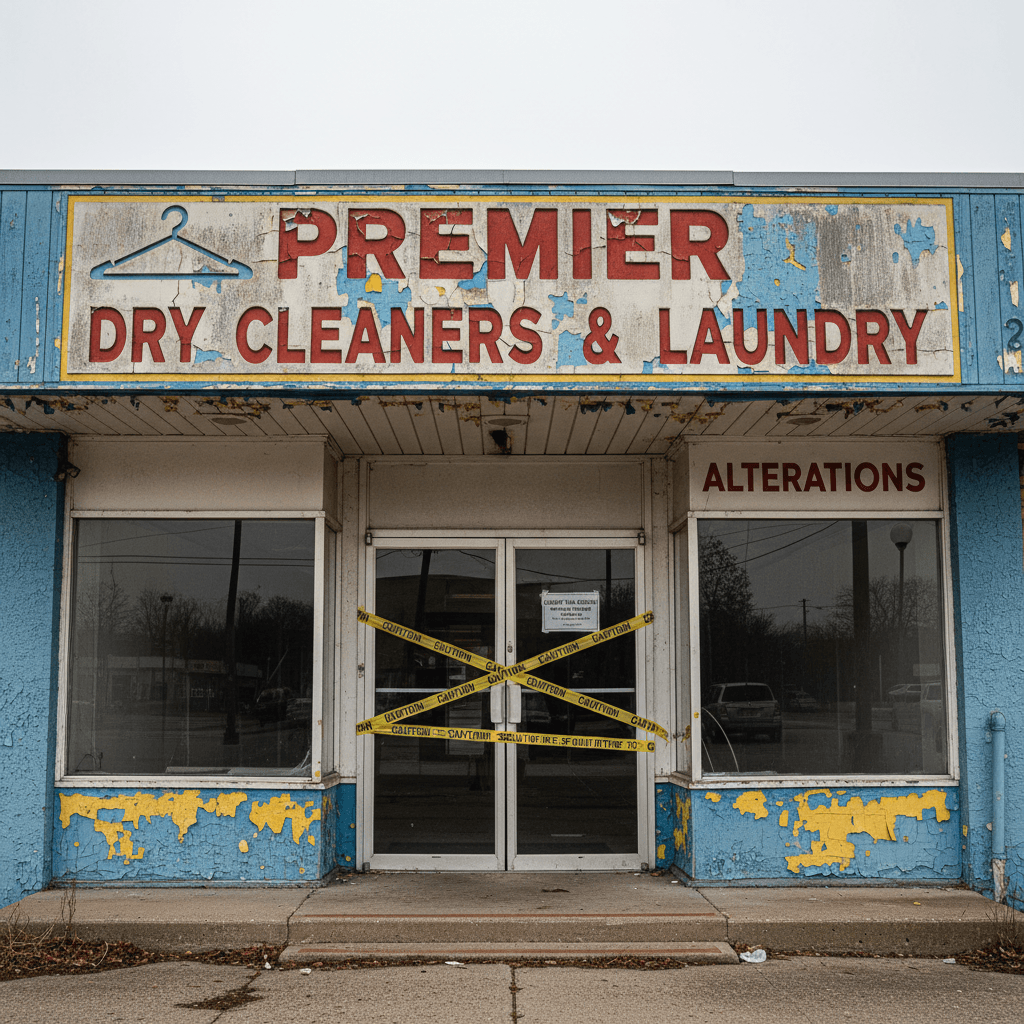
Why Dry Cleaning Properties Wind Up at Tax Deed Auctions
Dry cleaning operations are capital-intensive, heavily regulated, and highly sensitive to shifts in consumer behavior. When an owner can no longer sustain the business—whether because of declining revenue, operator illness, rising utility costs, or mounting regulatory fines—property taxes are often the first obligation to go unpaid. The cycle typically accelerates: an operator stops cleaning, chemical inventories sit unused, equipment falls into disrepair, and unpaid taxes accumulate until the county initiates a tax deed or tax lien foreclosure process.
The irony is that the same financial pressure that caused the tax delinquency often also left environmental problems festering. Owners who could not afford to pay taxes almost certainly could not afford the proper disposal of perchloroethylene (PERC) or the closure testing required by state environmental agencies. That means the property that lands at auction frequently carries a hidden chemical inventory in its soil and groundwater—one that the auction notice will never mention.
Understanding this pattern is the first step in evaluating any dry cleaning or commercial laundry site. The delinquency is not a random event; it is frequently correlated with neglect that extends well beyond the tax bill.
- Owners unable to sustain the business often skip both taxes and proper chemical disposal
- Regulatory violations and cleanup orders may already be on file before the auction
- Equipment vendors and lienholders may have claims that survive the tax deed sale
PERC Contamination: The Single Largest Risk at Dry Cleaning Sites
Perchloroethylene—commonly called PERC or PCE—is the dominant solvent used in dry cleaning operations throughout the United States. It is a dense, non-aqueous phase liquid (DNAPL) that migrates downward through soil and into groundwater, making it one of the most difficult and expensive environmental contaminants to remediate. The U.S. Environmental Protection Agency classifies it as a likely human carcinogen, and virtually every state environmental agency has specific regulations governing its use, storage, and cleanup.
When a dry cleaning operation discharges PERC—through floor drain releases, spills, or improper disposal of still bottoms—the contamination can spread laterally and vertically, affecting neighboring parcels and municipal water supplies. This creates liability that is not confined to the property boundaries. In many states, the current owner of a contaminated site can be held responsible for cleanup costs even if they had nothing to do with the original release. That principle applies directly to tax deed buyers who take title without conducting thorough environmental due diligence.
The critical point for investors is that PERC contamination is not always visible and is never disclosed at a tax deed auction. A Phase I Environmental Site Assessment can identify recognized environmental conditions, but only a Phase II assessment with soil borings and groundwater sampling can confirm whether contamination is present and begin to quantify remediation costs. Bidding on a dry cleaning property without at least a Phase I review is a significant, unquantifiable risk.
- PERC is a DNAPL that migrates through soil and groundwater beyond the property line
- New owners can face cleanup liability under state environmental laws regardless of who caused the contamination
- Phase I and Phase II environmental assessments are essential pre-bid due diligence tools
- State environmental agency records may already document spills, complaints, or enforcement actions at the specific address
Equipment Liens, UCC Filings, and Third-Party Ownership
Commercial dry cleaning equipment—solvent recovery units, pressing machines, boiler systems, spotting boards—represents a significant capital investment. Many operators finance this equipment through installment contracts or lease agreements, and the lenders or lessors file Uniform Commercial Code (UCC) financing statements with the secretary of state to perfect their security interest. Those UCC filings attach to the equipment, not the real property, and they generally survive a tax deed sale.
This creates a scenario where you acquire the building through the auction but arrive to find that the dry cleaning machinery inside is not yours. The equipment creditor retains the right to repossess the financed machinery, leaving you with a stripped shell of a commercial space and a floor plan designed around equipment you no longer have. You may also face a bill for the removal of that equipment, including any residual chemicals left in the machines.
Before bidding, search the secretary of state's UCC database in the state where the property is located under the entity name of the prior operator. Also check for any recorded fixture filings, which apply UCC protections to equipment that has become permanently affixed to the real property. Equipment that qualifies as a fixture may be treated differently under state law, but that determination requires careful legal analysis. Verifying with a licensed attorney before the auction is the prudent path.
- Search UCC filings under the operator's business name in the state's secretary of state database
- Fixture filings may attach equipment claims to the real property record
- Leased equipment owned by third parties can be repossessed after you acquire the deed
- Chemicals remaining in equipment at time of possession become your liability on closing
State and Local Regulatory Compliance Obligations
Dry cleaning facilities are subject to overlapping regulatory frameworks at the federal, state, and local level. The EPA's National Emission Standards for Hazardous Air Pollutants (NESHAP) for perchloroethylene dry cleaning facilities impose specific equipment and operational requirements. State environmental agencies layer additional rules on top of those federal standards. Local fire marshals, air quality districts, and building departments may each have their own compliance requirements.
When you acquire a dry cleaning property through a tax deed, you do not inherit the prior operator's licenses—those are personal to the licensee and do not transfer with the real estate. What you do potentially inherit is the ongoing obligation to address any open enforcement actions, compliance orders, or pending fines that relate to the condition of the property itself. An open notice of violation from the state environmental agency, for example, runs with the land and may require remediation before you can legally redevelop or sell the property.
Checking for open enforcement actions is straightforward: state environmental agency databases are generally public record and searchable by address. The EPA's ECHO (Enforcement and Compliance History Online) database also aggregates federal and state compliance data for regulated facilities. Running these searches before the auction takes less than an hour and can reveal whether the property is already on a regulatory radar screen.
- Check EPA ECHO for federal enforcement history at the property address
- Search the state environmental agency database for open cleanup orders or notices of violation
- Confirm whether the property is enrolled in a state dry cleaner remediation fund program
- Local building and fire departments may have separate open violation records to review
Title Issues, Redemption Rights, and Exit Strategy Complications
Tax deed properties involving commercial operations like dry cleaning face the same title challenges as other auction purchases, but the environmental and regulatory history adds layers that make resolving title more complex. Title insurers are acutely aware of dry cleaning contamination risk, and many will decline to issue a standard owner's policy—or will attach broad environmental exclusions—on any property with a former dry cleaning use, even if no contamination has been confirmed. That reluctance dramatically complicates your exit strategy.
If you plan to resell, your buyer will face the same title insurance challenge. If you intend to refinance, most lenders will require a clean environmental report before funding. Even if you plan to redevelop, the permitting process for a former dry cleaning site will almost always trigger an environmental review. Each of these paths requires documented proof that the contamination question has been addressed, which loops you back to the cost and time involved in a Phase II assessment and potentially a full remediation program.
Redemption rights also apply in many states: the prior owner, lienholders, or other parties may have a statutory window after the tax deed sale to redeem the property by paying off the tax debt plus any costs. If the property turns out to be environmentally compromised, the original owner has little incentive to redeem. That can work in your favor in terms of quiet title, but it also means you are unlikely to recover from a bad purchase through redemption. The right of redemption is not a buyer's safety net—it is the former owner's safety net. Confirm the applicable redemption period with the county and a licensed real estate attorney in the jurisdiction before you bid.
- Title insurers frequently exclude or limit coverage for properties with known or suspected PERC contamination
- Lender financing for resale or refinancing typically requires a satisfactory Phase II report
- Redemption periods vary by state; confirm the applicable window with the county clerk
- Quiet title actions may be required before the property can be conveyed with marketable title
Applying a Risk-Layered Evaluation Before the Auction
Dry cleaning and commercial laundry properties are not uninvestable—they can represent genuine opportunities for experienced investors who complete thorough due diligence and price the risk correctly. The key is to build every known risk layer into your maximum bid before the auction opens, not after you hold the deed.
Start with the environmental history: pull the state agency database, run EPA ECHO, and determine whether the property is enrolled in any state dry cleaner cleanup fund. Many states operate dedicated remediation funds that reimburse property owners for a portion of cleanup costs at eligible dry cleaning sites—that program status can materially affect your risk calculus. Next, run the UCC search to understand what equipment obligations may survive the sale. Then pull the county code enforcement and building department records for open violations. Finally, obtain a preliminary title report to understand what liens and encumbrances are already on record.
Only after completing those steps—ideally with the support of an environmental consultant, a title professional, and a real estate attorney licensed in the state—should you determine whether the property fits your investment criteria at any price. Tools that aggregate auction data, flag property risk factors, and surface liens before you bid can accelerate the screening process significantly, but they complement rather than replace hands-on due diligence for property types with this level of environmental exposure.
- Determine whether the state has a dry cleaner remediation fund and whether this site is eligible
- Quantify environmental, equipment, and title risk layers before setting a maximum bid
- Engage an environmental consultant for Phase I review prior to bidding on any suspect site
- Verify open liens, violations, and redemption windows with county records and licensed professionals
It's the 3% that bankrupts beginners
95% of tax liens get paid. TaxDeedIQ finds the risky ones, the junk land, the surviving IRS lien, before you bid.
Try it free for 7 daysDry Cleaning and Laundry Facilities at Tax Deed Auctions FAQ
Does buying a dry cleaning property through a tax deed sale protect me from prior environmental liability?
No. Taking title through a tax deed does not insulate you from state or federal environmental cleanup obligations. Many state environmental laws impose liability on the current owner of a contaminated property regardless of who caused the contamination. The tax deed conveys the real property as-is, and that includes any environmental conditions attached to the land. Conduct a Phase I Environmental Site Assessment before bidding and consult a licensed environmental attorney about your exposure in the specific state.
Can equipment inside a dry cleaning facility be taken after I buy the property at auction?
Yes, in many cases. If the prior operator financed or leased the dry cleaning equipment, the creditor or lessor likely filed a UCC financing statement perfecting their interest in that equipment. That security interest generally survives the tax deed sale because it attaches to the personal property, not the real estate. Search the secretary of state's UCC database under the prior operator's name before bidding so you understand what equipment, if any, is subject to a third-party claim.
What is a state dry cleaner remediation fund, and how does it affect my investment?
Several states have created dedicated remediation funds—funded through surcharges on solvent purchases or licensing fees—that reimburse eligible parties for a portion of cleanup costs at dry cleaning contamination sites. If the property you are evaluating is already enrolled in such a program, that can reduce your out-of-pocket remediation exposure, though program eligibility rules, coverage caps, and waiting lists vary significantly by state. Confirm enrollment status and program terms with the state environmental agency before factoring any fund reimbursement into your underwriting.
How do I find out if a dry cleaning property already has open regulatory enforcement actions?
The EPA's ECHO database (echo.epa.gov) aggregates federal and state compliance and enforcement history for regulated facilities and is searchable by address. Most state environmental agencies also maintain public-facing databases of cleanup sites, notices of violation, and consent orders. Searching both sources by the property's street address before the auction takes minimal time and can reveal whether the property is already the subject of an active cleanup order or pending fine.
Why might I have difficulty getting title insurance on a former dry cleaning property?
Title insurers assess the risk that a future claim could impair your ownership. For dry cleaning properties, they are concerned that environmental cleanup orders or liens could cloud title or result in government action against the property. Even in the absence of confirmed contamination, the mere prior use as a dry cleaning facility can cause underwriters to decline coverage or attach broad environmental exclusions. Without title insurance, resale and refinancing become significantly more difficult, so the feasibility of your exit strategy should be evaluated before you bid, not after.
More guides
- Tax Deed vs Tax Lien: What's the Difference? (2026 Guide)
- Is Tax Deed Investing Safe? 6 Risks to Check Before You Bid
- Tax Deed Surplus Funds: How Overbid Recovery Works
- Redeemable Deed States Explained (Georgia, Texas & More)
- Nightclubs and Bars at Tax Deed Auctions: Liquor License Gaps, Code Violations, and the Risks Every Investor Must Evaluate Before Bidding
- nope
Informational only, not legal or investment advice. Confirm rules with the county and consult a licensed professional before bidding.