Breweries, Distilleries, and Wineries at Tax Deed Auctions: Licensing Gaps, Equipment Liens, and the Risks Every Investor Must Evaluate Before Bidding
A craft brewery or distillery auctioned for unpaid property taxes looks attractive on paper—specialized infrastructure, strong market demand, and potential rental income from day one. But beneath the stainless-steel tanks and tasting room floors lies a tangle of federal permits, state liquor licenses, equipment financing agreements, and environmental exposures that can turn a winning bid into an expensive lesson. Evaluating every risk layer before you place that bid is not optional—it is the entire job.
Why Craft Beverage Properties End Up at Tax Deed Auctions
Craft beverage operations—breweries, distilleries, cideries, meaderies, and farm wineries—run on thin margins and capital-intensive infrastructure. When a business fails, the owner often stops paying property taxes long before the doors officially close. By the time a parcel reaches a tax deed or tax lien foreclosure auction, the underlying business may already be legally defunct, the equipment may have been repossessed, and the state liquor license may have lapsed or been revoked. The property itself, however, remains and eventually surfaces at auction.
Understanding why these properties go delinquent helps you anticipate what you will find. Equipment financing is common in the brewing and distilling world—grain mills, fermenters, bright tanks, bottling lines, and barrel warehouses are frequently purchased through chattel loans or leases. Those obligations are attached to the equipment, not the real estate, meaning the lender may have a perfected UCC financing statement that survived the tax deed sale entirely. Confirm through a UCC search with the Secretary of State before bidding.
- Business closure often precedes tax delinquency by months or years
- Equipment may be collateral under separate chattel financing
- State licenses frequently lapse once the business stops operating
- Specialized infrastructure has limited alternative use without rezoning
Federal TTB Permits: What They Are and Why They Cannot Be Transferred
The Alcohol and Tobacco Tax and Trade Bureau (TTB) issues federal operating permits to every manufacturer of beer, wine, or distilled spirits sold in interstate or intrastate commerce. A Brewer's Notice, a Distilled Spirits Plant (DSP) permit, or a Winery Bond is personal to the business entity that applied for it. When you acquire the real property through a tax deed auction, you do not acquire the TTB permit. You acquire four walls and specialized plumbing.
This distinction is critical. If you plan to operate the facility as a beverage manufacturer—or lease it to a future operator—that operator must file a new application with TTB and receive approval before a single gallon is produced. TTB's approval process involves background checks, bond requirements, and facility inspections. Processing times can extend for months. During that window, the facility generates no income from its intended use. If your underwriting assumed immediate operational revenue, re-run your numbers accounting for a permit approval gap.
- TTB Brewer's Notice, DSP permit, and winery bond are entity-specific—not property-specific
- New owners or tenants must apply fresh; there is no assignment mechanism
- Approval timelines vary by permit type and TTB workload
- Any unpaid federal excise tax obligations of the prior licensee are not your debt, but confirm with a tax attorney
State Liquor Licenses and the Tasting Room Problem
Every state that permits on-site tasting rooms—and nearly all do now—requires a separate state retail or manufacturer license in addition to the federal TTB permit. State liquor control boards do not transfer licenses with real estate. A new operator must apply, pass a background check, pay applicable fees, and in some states go through a public notice and protest period before the license is granted.
The complication deepens when the prior operator's license was revoked for cause—for example, for selling to minors, failing inspections, or financial malfeasance. Some state boards track revocation history by premises address, not just by entity. A new applicant at that same address may face heightened scrutiny, a mandatory waiting period, or outright denial depending on the state's administrative rules. Before bidding, contact the state's liquor control authority and ask whether any adverse licensing history is associated with the specific address. That inquiry costs nothing and can save you a great deal.
Additionally, many states impose local approval requirements—a city or county may need to issue a conditional use permit or a local license endorsement before the state license becomes active. If the property sits in a jurisdiction that has become hostile to alcohol manufacturing since the original license was issued, you may face a rezoning or conditional use battle as a precondition to reopening.
- State manufacturer and retail licenses are not transferred by deed
- Revocation history tied to an address can complicate new applications
- Local conditional use permits may be required separately from state licenses
- Confirm current zoning permits the manufacturing and retail use you intend
Environmental Exposure: Wastewater, Spent Grain, and Chemical Storage
Beverage manufacturing produces significant wastewater with elevated biological oxygen demand (BOD). Many craft facilities operate under a pretreatment permit issued by the local publicly owned treatment works (POTW) or, in rural areas, under a state-issued discharge permit for land application or on-site treatment systems. When a business closes and stops maintaining that system, violations can accumulate silently.
A brewery or distillery that allowed its wastewater system to fall out of compliance may have outstanding enforcement orders from the state environmental agency. Those orders do not disappear with the tax deed. As the new property owner, you inherit the obligation to bring the system into compliance before resuming operations—and potentially before selling to a future operator who wants to use it as a beverage facility.
Beyond wastewater, consider cleaning chemical storage. Industrial brewing and distilling require caustic cleaning agents, acids, and sanitizers. If these were stored improperly or if there was a spill, you may be dealing with a contamination issue that requires investigation before any lender or future buyer will touch the asset. Order a Phase I Environmental Site Assessment as part of your pre-bid due diligence. If the Phase I flags concerns, a Phase II with soil sampling may be warranted—ideally before the auction, not after.
- Wastewater pretreatment permits are facility-specific and may have outstanding violations
- Caustic chemical storage can create soil or groundwater contamination
- Phase I ESA is a minimum; Phase II may be needed if the Phase I flags recognized environmental conditions
- On-site wastewater systems in rural locations may require separate state permits to restart
Equipment, Infrastructure, and the Hidden Cost of a Bare Shell
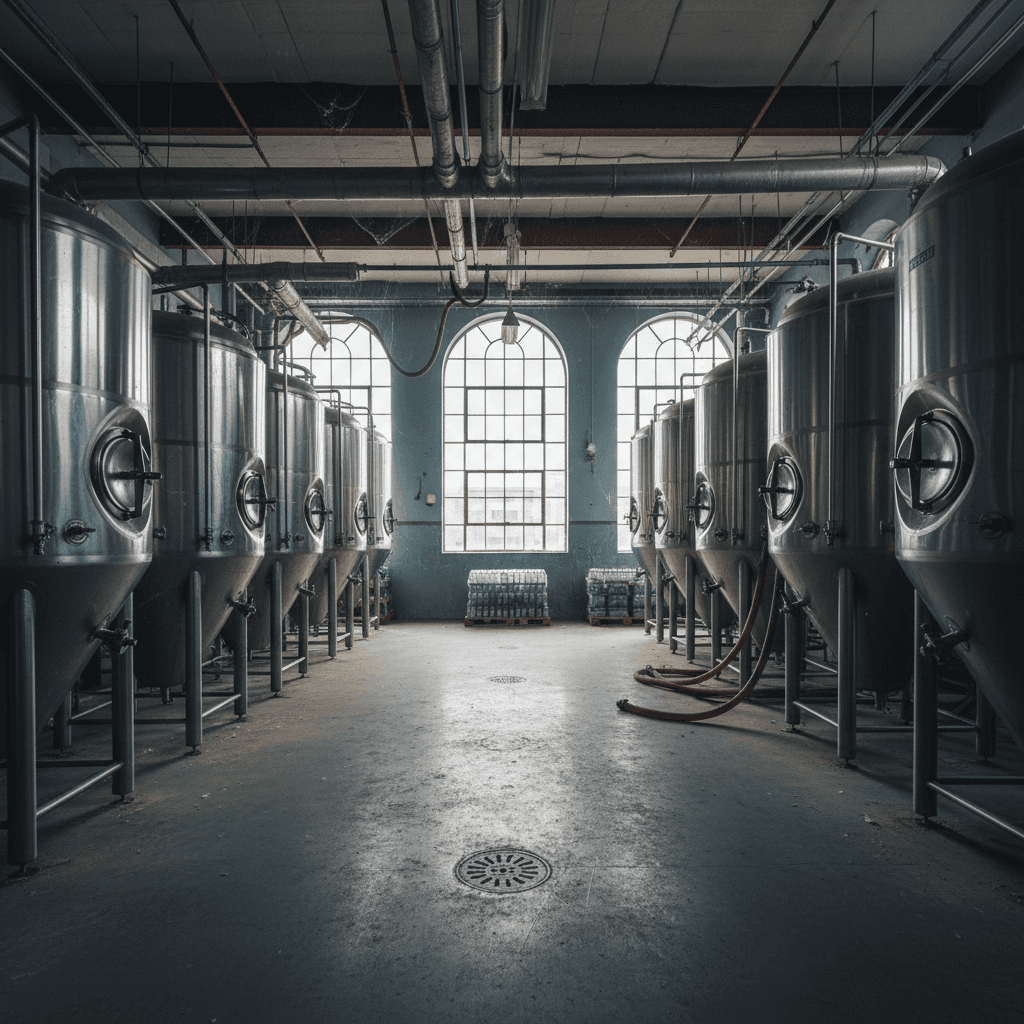
One of the most common surprises for investors who win a brewery or distillery at auction is discovering that the building is essentially an empty shell. Prior creditors—equipment lenders, landlords who had a lien on improvements, or the business's secured lender—may have already removed or repossessed the core production equipment before or after the tax sale.
A brewing facility without tanks, kettles, or a grain handling system is an industrial building with specialized utility hookups. The floor drains, reinforced flooring, high-amperage electrical service, and commercial HVAC are valuable, but converting the space to a different use may require substantial renovation and a new certificate of occupancy. The gap between what you assumed would be there and what actually remains is a risk that only a physical inspection and a review of UCC lien records can close.
Confirm through the county recorder and the Secretary of State's UCC database which pieces of equipment, if any, are still subject to outstanding financing statements. A perfected UCC-1 fixture filing gives the secured party rights to remove equipment even after a tax deed conveyance in many states. Consult a local attorney on the interaction between the tax deed and any fixture filings in that specific jurisdiction before you bid.
- Equipment may have been legally repossessed prior to or after the tax sale
- UCC-1 fixture filings can survive the tax deed and give lenders removal rights
- Specialized utilities (high-amperage power, gas lines, floor drains) add value for beverage use but are expensive to repurpose
- Obtain a physical inspection if possible; if the property is padlocked, build an inspection contingency assumption into your maximum bid
Zoning, Use Restrictions, and Agricultural Designations for Farm Wineries
Craft beverage facilities sit at the intersection of industrial, commercial, and in the case of farm wineries, agricultural zoning. A farm winery operating under an agricultural exemption may be sited on land that is not zoned for general commercial food and beverage manufacturing. The exemption was personal to the licensed farm winery. After a tax deed sale, the new owner may lose the ability to use the parcel for any alcohol-related commercial activity without a rezoning, a conditional use permit, or a special exception hearing.
For urban or suburban breweries and taprooms, the use may hinge on a specific conditional use permit that was tied to the previous operator's business plan and operating conditions. Some conditions run with the land; others expire when the original permittee ceases operations. Call the local planning department and ask specifically whether the conditional use permit for beverage manufacturing is still active, assignable, and what conditions attach to it.
Zoning complexity is amplified when the property straddles municipal boundaries or when surrounding land uses have changed since the original permit was issued. A neighborhood that accepted a small craft brewery ten years ago may now have a residential development next door whose homeowners association has the standing to object to a renewal application. Evaluate the current neighborhood context, not just the historical zoning approval.
- Farm winery agricultural exemptions may not transfer to new owners
- Conditional use permits for taprooms or tasting rooms may have expired
- Surrounding land use changes can affect the ability to renew or transfer permits
- Confirm all active permits with both the planning department and the state liquor authority
How to Evaluate a Craft Beverage Property Before You Bid
Risk evaluation for a brewery, distillery, or winery at auction follows the same fundamental framework as any tax deed purchase, but with additional layers specific to the beverage industry. Work through each layer systematically before establishing your maximum bid.
Start with the county records: verify the legal description, confirm no other tax liens remain from adjacent parcels, and check for outstanding code enforcement orders. Move to the state liquor control board to understand the license history at the address. Query the TTB's public permit database to identify what federal permits were held and whether they are currently active or terminated. Run a UCC search at the Secretary of State to identify equipment financing statements. Order a Phase I ESA. And if at all possible, walk the property—even a drive-by reveals whether tanks are still present or whether the building has been stripped.
Tools like TaxDeedIQ can help you surface and organize risk signals before auction day, flagging issues such as federal liens, environmental notices, and other encumbrances so you are not building your analysis from scratch on each parcel. But no platform replaces a licensed attorney, a licensed environmental professional, and a physical inspection for a property with this level of operational complexity.
- Review county records for outstanding code violations and additional tax liens
- Query the state liquor board for license history at the property address
- Search TTB's public database for federal permit status
- Run a UCC search through the Secretary of State for equipment financing statements
- Order a Phase I ESA before bidding if at all possible
- Consult a local attorney familiar with both tax deed law and alcoholic beverage regulation
Free: the 50-State Tax-Sale Rules
Redemption periods, lien vs. deed, interest rates, every state. Plus a 0–100 risk score on every auction.
Get started freeBreweries, Distilleries, and Wineries at Tax Deed Auctions FAQ
Does buying a brewery at a tax deed auction give me the right to operate it as a brewery immediately?
No. The tax deed conveys the real property only. To operate as a brewery, distillery, or winery, a new entity must separately obtain a TTB federal permit and a state manufacturer's license—and potentially local conditional use approval. Each of these processes takes time, involves background checks and inspections, and is not guaranteed to succeed. Plan for a gap between acquisition and operational use.
Can equipment inside the building be removed by a prior lender after I win the tax deed?
Potentially yes. If a prior lender holds a perfected UCC-1 fixture filing or chattel security interest on specific equipment, that lender may have rights to the collateral that survive the tax deed in some states. The interaction between UCC security interests and tax deed conveyances is jurisdiction-specific. Run a UCC search before bidding and have a local attorney review any active fixture filings against the parcel.
What happens to outstanding wastewater violations or environmental orders when I acquire the property?
Environmental compliance obligations and enforcement orders generally attach to the property and its owner, not just the prior operator. As the new owner, you may be required to bring the facility into compliance before resuming operations or before transferring to a future buyer. A Phase I Environmental Site Assessment before bidding is the minimum standard; a Phase II may be warranted if the Phase I identifies recognized environmental conditions.
Is there any way to verify the state liquor license history for a craft beverage property before bidding?
Yes. Most state liquor control boards maintain public databases or will respond to public records requests. Search the property address—not just the prior owner's name—to identify any revocation, suspension, or pending enforcement history tied to that location. Some states make this information available online; others require a written inquiry. Either way, make the call before auction day.
What if the farm winery was operating under an agricultural zoning exemption? Does that transfer?
Agricultural use exemptions for farm wineries are typically tied to the licensed operator and their compliance with the state's farm winery statute—including requirements such as growing a minimum percentage of fruit on-site. A new owner would need to independently qualify for and apply for the same exemption, meeting all current statutory requirements. If those requirements have changed since the original license was issued, or if the new owner does not intend to farm the land, the exemption may not be available and rezoning could be required.
More guides
- Tax Deed vs Tax Lien: What's the Difference? (2026 Guide)
- Is Tax Deed Investing Safe? 6 Risks to Check Before You Bid
- Tax Deed Surplus Funds: How Overbid Recovery Works
- Redeemable Deed States Explained (Georgia, Texas & More)
- Nightclubs and Bars at Tax Deed Auctions: Liquor License Gaps, Code Violations, and the Risks Every Investor Must Evaluate Before Bidding
- nope
Informational only, not legal or investment advice. Confirm rules with the county and consult a licensed professional before bidding.