Flood Zones, FEMA Maps, and Natural Hazard Risk at Tax Deed Auctions: What Every Investor Must Evaluate Before Bidding
A tax deed can look like a bargain right up until you discover the property sits in a FEMA Special Flood Hazard Area, mandatory flood insurance costs more than the property taxes ever did, and financing is essentially impossible. Flood zones and other natural hazard designations are among the most underestimated risks in tax deed investing — they don't show up on a deed, and county auction staff rarely volunteer the information. Evaluating these risks before the gavel falls is not optional; it is the difference between an asset and a permanent liability.
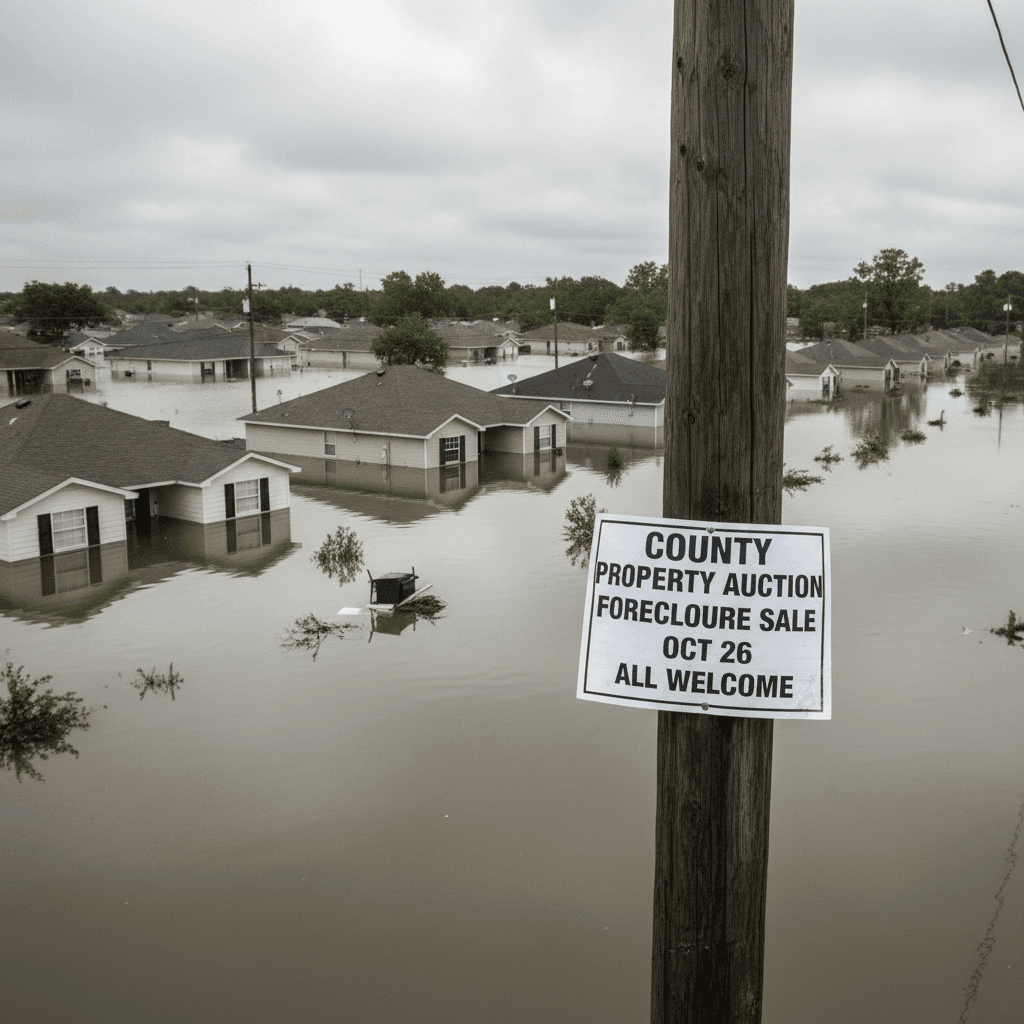
Why Natural Hazard Risk Is Especially Dangerous at Tax Deed Auctions
Unlike a traditional real estate purchase, a tax deed sale typically offers no seller disclosures, no inspection contingency, and no financing period during which a lender's underwriter might flag a problem. You win the bid, you own the property — full stop. That compressed transaction structure means every risk you would normally catch through the conventional sales process has to be discovered on your own before you raise your paddle.
Natural hazard designations — flood zones, wildfire risk zones, seismic zones, and coastal high-hazard areas — follow the land, not the owner. A prior owner who defaulted on property taxes did not remove the property from FEMA's Flood Insurance Rate Map. The hazard designation that existed the day the previous owner stopped paying taxes is the same one you will inherit when the deed is transferred to you. And depending on the hazard category, the financial consequences can range from mildly inconvenient to deal-breaking.
FEMA Flood Zones: What the Designations Actually Mean for Investors
FEMA publishes Flood Insurance Rate Maps (FIRMs) that assign every mapped parcel in the United States to a flood zone designation. The designations most critical to investors are Zone A and Zone AE (high-risk areas with a roughly 1-in-100 annual flood chance), Zone AO and Zone AH (shallow flooding zones), and Zone VE (coastal high-hazard areas subject to wave action). Properties in these Special Flood Hazard Areas carry mandatory purchase requirements for any federally backed mortgage.
Even if you plan to pay cash, the insurance obligation doesn't disappear. Any future buyer who needs a mortgage will be required to carry flood insurance if the property is in a mapped SFHA, and that insurance premium will factor into their affordability calculation — and therefore into what they are willing to pay you. In high-risk zones or areas with repeated loss history, premiums can be substantial and can rise significantly over time as FEMA continues to update its risk rating methodology.
Zone X properties — those designated as moderate or minimal risk — are not immune either. A property can sit just outside the Special Flood Hazard Area boundary on paper while still experiencing routine surface flooding, basement intrusion, or drainage problems. The FEMA map is a starting point for due diligence, not the final word on actual flood frequency.
- Zone A / AE: High-risk, 100-year floodplain, mandatory insurance for federally backed loans
- Zone VE: Coastal high-hazard, wave action risk, most expensive to insure and hardest to finance
- Zone AO / AH: Shallow flooding or ponding, often overlooked by inexperienced bidders
- Zone X (shaded): Moderate risk, no mandatory requirement but flooding can still occur
- Zone X (unshaded): Minimal mapped risk, but field conditions may differ from the map
How to Check Flood Zone Status Before an Auction
FEMA's Flood Map Service Center at msc.fema.gov is the authoritative source for current Flood Insurance Rate Maps. You can search by address or parcel number and pull the relevant FIRM panel for any property you are researching. Pay attention to the effective date of the map — some counties are operating on maps that are years or decades old, meaning the official designation may understate current risk in areas where development, climate patterns, or drainage infrastructure has changed.
A LOMA (Letter of Map Amendment) or LOMR (Letter of Map Revision) can change a parcel's official zone without the base map being updated, so it is worth checking FEMA's Letter of Map Change database as well. Conversely, a property that appears to be in Zone X on the current map may be subject to a pending map revision that would reclassify it into the SFHA after you take ownership.
Many counties also publish their own GIS layers showing flood zones alongside parcel data. Some online auction platforms link to county GIS directly, but the data currency and accuracy varies. Cross-referencing at least two sources — FEMA's map and the county's own GIS — is a reasonable minimum standard before bidding on any property near a waterway, coastal area, or flat terrain that drains poorly.
Wildfire, Seismic, and Other Natural Hazard Designations
Flood is the most universally regulated natural hazard in the United States, but it is not the only one that can damage the economics of a tax deed investment. In western states, wildfire risk zones are increasingly scrutinized by insurers, and in some high-risk areas property insurance — not just flood insurance — has become difficult or expensive to obtain. A parcel in a state-designated Fire Hazard Severity Zone in California, for example, may face insurer non-renewal or dramatically higher premiums that directly affect resale value and rentability.
Seismic hazard zones are relevant in California, the Pacific Northwest, and parts of the central United States near major fault systems. While there is no federal insurance mandate tied to seismic zones the way there is for flood, buildings in high seismic hazard areas may require retrofit work to meet current code standards — work that becomes your responsibility the moment you take title.
Coastal erosion, subsidence, and sinkhole designations are also property-level risks worth investigating in relevant geographies. Florida, for instance, has documented sinkhole activity in several counties, and the cost of remediation — along with the difficulty of obtaining sinkhole insurance after a claim has been filed on a property — can make an otherwise appealing tax deed purchase into a permanent financial drain. None of these hazards will be disclosed to you at the auction. You have to find them yourself.
- Wildfire: Check state fire agency maps; insurance availability shrinking in high-risk zones
- Seismic: Review USGS Quaternary Fault database for properties near active fault traces
- Sinkhole: Florida Geological Survey maintains a sinkhole incident database by county
- Coastal erosion: NOAA and state coastal management agencies publish shoreline change data
- Wind/hail: Check ISO wind zone maps and local building code requirements for storm-resistant construction
How Hazard Designations Affect Your Exit Strategy and Financing Options
Even if you plan to hold a property as a rental or fix it and sell it for cash, your pool of eventual buyers is shaped by every hazard designation attached to the parcel. A buyer who needs a conventional mortgage on a property in Zone AE will be required to escrow flood insurance premiums through their lender. If those premiums are high enough, the property effectively becomes cash-only — which significantly limits demand and therefore price.
Properties in FEMA-designated SFHAs that receive federal disaster assistance are also subject to the requirement that they maintain flood insurance continuously, or they may become ineligible for future disaster relief. That ongoing obligation transfers with ownership and can deter buyers who are unfamiliar with its implications.
Insurance availability itself is a constraint investors often ignore until it's too late. In some high-risk markets, private insurers have pulled back, leaving only government programs — which may impose coverage limits below the replacement cost of a structure. If the cost to rebuild after a loss exceeds your insurance recovery, the gap becomes your problem. Evaluating that gap is part of evaluating the real acquisition cost of a tax deed property, and it should happen before you set your maximum bid — not after.
Tools like TaxDeedIQ are designed to surface these kinds of pre-bid risk signals — including flood zone indicators — alongside the auction data itself, so investors can make faster and more informed decisions without having to manually cross-reference every hazard database for every parcel they consider. That kind of integrated risk visibility is especially valuable when you are evaluating a large number of properties across multiple counties or states.
Score every auction before you bid
TaxDeedIQ gives every US tax deed & tax lien auction a 0–100 safety score, surviving liens, IRS redemption, flood, homestead.
Start my free trialFlood Zones, FEMA Maps, and Natural Hazard Risk at Tax Deed Auctions FAQ
Does a property in a flood zone automatically disqualify it as a tax deed investment?
Not automatically, but it significantly changes the math. You need to account for mandatory flood insurance costs, the effect on financing options for future buyers, and whether the structure's elevation reduces or increases the premium. Some flood zone properties pencil out at the right price; others never do. The key is knowing the designation and estimating the insurance cost before you set your bid limit, not after you win.
Can I check flood zone status on the county's website before auction day?
Many counties publish GIS maps that include FEMA flood zone layers, and those are a useful starting point. However, the most authoritative source is FEMA's Flood Map Service Center at msc.fema.gov. You should also check for any Letters of Map Amendment or Revision that may have updated a specific parcel's status after the base map was published. Using both sources together gives you a more complete picture than relying on the county alone.
If the previous owner never carried flood insurance, does that mean I don't have to?
No. Flood insurance is required based on the property's current flood zone designation and how the purchase is financed — not on the prior owner's behavior. If you finance the purchase with a federally backed loan on an SFHA-designated property, your lender will require insurance. If you buy cash and later sell to a buyer who needs a mortgage, their lender will impose the same requirement. The prior owner's non-compliance doesn't alter the federal mandate that attaches to the property.
What happens if a flood map revision reclassifies my property into a higher-risk zone after I buy it?
FEMA periodically updates its flood maps, and properties can move from Zone X into the Special Flood Hazard Area through a map revision. If that happens after you take ownership, you may become subject to mandatory insurance requirements if you carry a federally backed mortgage, and your insurance costs will increase. Monitoring FEMA's map revision schedule for your target counties — available through the Flood Map Service Center — is a reasonable part of ongoing risk management.
More guides
- Tax Deed vs Tax Lien: What's the Difference? (2026 Guide)
- Is Tax Deed Investing Safe? 6 Risks to Check Before You Bid
- Tax Deed Surplus Funds: How Overbid Recovery Works
- Redeemable Deed States Explained (Georgia, Texas & More)
- The IRS 120-Day Redemption Right: What Every Tax Deed Investor Must Know Before Bidding on a Property With a Federal Tax Lien
- Title Insurance After a Tax Deed Sale: Why You Can't Always Get It, and What Smart Investors Do Instead
Informational only, not legal or investment advice. Confirm rules with the county and consult a licensed professional before bidding.