Printing and Publishing Facilities at Tax Deed Auctions: Equipment Liens, Hazmat Liability, and the Risks Every Investor Must Evaluate Before Bidding
Printing and publishing facilities look like industrial bargains on the auction sheet — large footprints, heavy infrastructure, often in established commercial corridors. But beneath that appealing surface sit equipment financing agreements that can outlast the tax deed, decades of solvent and ink waste that the EPA does not forget, and zoning classifications that may prohibit the use you have in mind. Evaluate every risk layer before you bid.
Why Printing Facilities End Up at Tax Deed Auctions
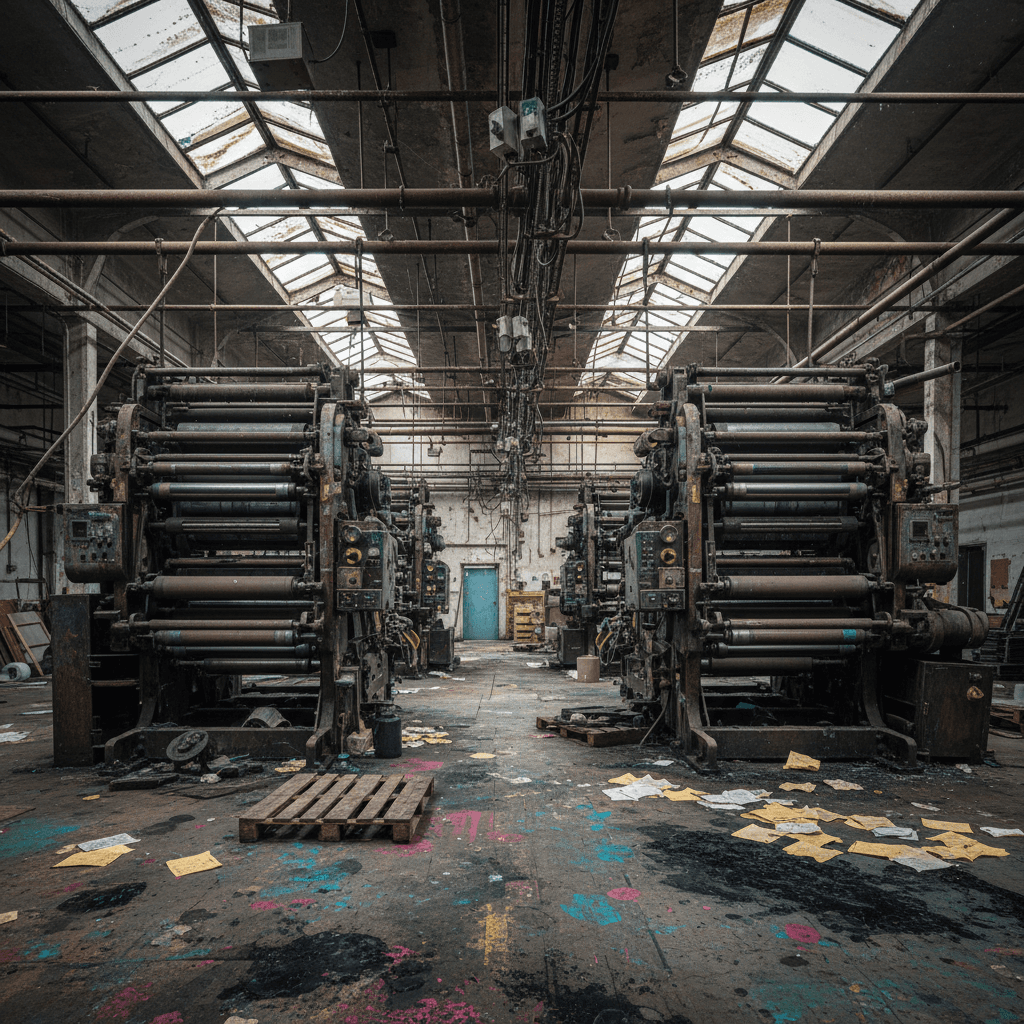
Commercial printing has been contracting for years as digital media displaces print runs. That contraction leaves owners with aging presses, declining revenue, and property tax bills they cannot sustain. When the taxes go delinquent long enough, the county initiates the tax deed or tax lien foreclosure process and the property eventually surfaces at auction. The building may still contain presses, bindery equipment, chemical tanks, and electrical infrastructure purpose-built for industrial print production — none of which transfers ownership cleanly just because a tax deed changed hands.
Understanding why these properties fail helps you anticipate what you will find. A printer that defaulted on both its mortgage and its equipment financing agreements likely left behind multiple creditors with recorded interests. The tax deed wipes out many junior liens, but the interaction between equipment security interests, fixture filings, and real property liens is complex enough that even experienced attorneys disagree on exactly what survives in a given state. That ambiguity is your financial risk.
- Secular decline in commercial print volumes driving owner insolvency
- Multiple creditors — equipment lenders, landlords, trade suppliers — often involved
- Properties frequently carry deferred maintenance and outdated electrical systems
- Auction purchasers inherit whatever the prior owner left inside
Equipment Liens, UCC Fixture Filings, and What Survives the Tax Deed
Printing presses are expensive. A large offset press can cost as much as a residential property, and lenders who finance that equipment protect themselves with UCC Article 9 security agreements and, critically, fixture filings recorded in the county real property records. A fixture filing treats the equipment as so integrated with the real estate that the lender's interest attaches to the property itself — not just to the movable asset.
Whether a tax deed extinguishes a fixture filing depends on state law, the timing of the filing relative to the tax lien, and whether the equipment lender received proper notice during the tax foreclosure process. If notice was deficient — a due process problem that courts review carefully — the fixture lien may survive your deed and give the equipment lender the right to repossess the press or force a sale. You could win the auction, take possession of the building, and then watch a creditor cart away the most valuable assets on the floor.
Always search the county recorder's office and the Secretary of State's UCC index for fixture filings against the property address before you bid. Cross-reference the debtor name with active UCC continuations. A filing that lapsed does not necessarily mean the debt is gone — it means the lender's perfected priority may have changed, but the underlying debt and any state-law remedies may still exist.
- Search UCC fixture filings at both county recorder and Secretary of State
- Check whether notice was served on equipment lenders during the foreclosure
- Confirm whether press machinery meets the legal definition of a fixture in your state
- Consult a commercial attorney before bidding on any property with active fixture filings
Hazardous Materials and Environmental Liability at Printing Plants
Commercial printing historically relied on petroleum-based inks, fountain solutions containing isopropyl alcohol, blanket wash solvents, plate developers, and in older facilities, chlorinated degreasing agents. Many of these compounds are listed hazardous substances under CERCLA and state environmental programs. If they were stored improperly, spilled, or disposed of on-site, the contamination does not disappear when the property changes hands at auction.
CERCLA's liability framework is strict, joint, and several, meaning a new owner can be held responsible for cleanup costs even if the contamination predates their ownership, with limited exceptions for bona fide prospective purchasers who conduct all appropriate inquiry before closing. A tax deed auction is not a typical real estate closing, and courts have disagreed on whether winning a bid at a county tax deed sale constitutes sufficient inquiry to claim that protection. Do not assume the exception applies to you without independent legal analysis.
A Phase I Environmental Site Assessment is the minimum standard of inquiry. For a printing facility with any operating history, a Phase II with soil and groundwater sampling is often warranted. If the Phase II reveals contamination, get a remediation cost estimate before bidding — cleanup costs can exceed the property's market value. Some states maintain voluntary cleanup programs with liability protections upon completion, but enrollment takes time and money, and the property may be unsellable or unmortgageable in the interim.
- Common contaminants: petroleum-based inks, chlorinated solvents, spent developers
- CERCLA strict liability can attach to new owners even post-tax deed
- Phase I ESA is minimum; Phase II sampling often necessary for operating print sites
- Remediation cost estimates should inform your maximum bid price
Zoning, Permitted Use, and the Adaptive Reuse Problem
A large printing plant is typically zoned heavy industrial or light industrial with specific use permits tied to the printing operation. If you intend to continue a printing operation, the zoning may work in your favor — but you will still need to verify that any conditional use permits or business licenses associated with the prior operator are transferable, which they often are not. Permits issued to a specific business entity generally lapse when that entity dissolves or abandons the property.
If your plan is adaptive reuse — converting the floor plate to warehouse, creative office, residential lofts, or any other use — you face a layered approval process. Industrial-to-residential conversions in particular trigger environmental review, building code upgrades, and in many jurisdictions, inclusionary housing requirements that can materially change the economics. Heavy electrical service designed for presses may be a genuine asset for certain tech or manufacturing tenants, but the cost to decommission the press pits, trenching, and chemical storage infrastructure can be substantial.
Check the current zoning designation and the future land use map in the county's comprehensive plan. If the parcel is in an area slated for industrial preservation, local ordinances in some cities actively restrict conversion away from industrial uses to protect employment zones. Discovering that restriction after you win the auction is an expensive lesson.
- Confirm zoning classification and permitted uses with the local planning department
- Verify transferability of any conditional use permits or variances
- Assess decommissioning costs for pits, trenching, and chemical storage
- Review future land use designations and industrial preservation overlay districts
Title Defects, Redemption Rights, and the Exit Strategy Problem
Printing facilities, like other specialized industrial properties, have a narrow buyer pool. Even if you resolve the environmental issues, clear the equipment liens, and complete a quiet title action, you may be holding a large, odd-shaped industrial building in a secondary market with limited comparable sales. That illiquidity is a risk that the auction excitement obscures.
The right of redemption — which allows the prior owner to reclaim the property by paying back taxes, interest, and costs within a statutory window — is a live concern at any tax deed auction. For a printing facility, the prior owner may have sold or scrapped equipment already, further complicating the picture. If redemption occurs after you have invested in environmental testing and legal fees, those sunk costs are typically non-recoverable.
Title insurance after a tax deed sale is notoriously difficult to obtain. Many national underwriters will not issue a standard owner's policy until a quiet title action has been completed and a court has adjudicated the validity of the deed. For a printing facility with the additional clouds described above — fixture filings, potential environmental liens recorded by state agencies, and due process notice questions — the quiet title process can be protracted. Budget for the time and legal expense before you bid, and treat the quiet title cost as part of your all-in acquisition price.
A tool like TaxDeedIQ can help you identify the risk layers attached to a specific parcel before you show up to bid — surfacing recorded liens, flood zone designations, homestead status, and IRS redemption flags in a single Safety Score. That pre-auction review does not replace the Phase I assessment or the attorney's title opinion, but it ensures you are not walking into the room blind.
- Redemption windows vary by state — confirm the exact period for the county you are bidding in
- Title insurance likely unavailable without a completed quiet title action
- Quiet title costs and timelines should be modeled into acquisition economics
- Use pre-auction research tools to surface lien and risk layers before bidding
It's the 3% that bankrupts beginners
95% of tax liens get paid. TaxDeedIQ finds the risky ones, the junk land, the surviving IRS lien, before you bid.
Try it free for 7 daysPrinting and Publishing Facilities at Tax Deed Auctions FAQ
Do equipment liens on printing presses survive a tax deed sale?
It depends on state law and whether the equipment lender received proper notice during the foreclosure. Fixture filings recorded before the tax lien may survive if the lender's due process rights were not satisfied. Search the county recorder and the Secretary of State UCC index for fixture filings before you bid, and have an attorney review any active filings.
Am I responsible for environmental cleanup at a printing plant I buy at a tax deed auction?
Potentially yes. CERCLA imposes strict liability on current property owners regardless of when contamination occurred. The bona fide prospective purchaser defense requires all appropriate inquiry before purchase. Whether a tax deed auction satisfies that standard is a legal question that varies by circumstance. Commission a Phase I Environmental Site Assessment — and if warranted, a Phase II — before you bid and before you close.
Can I convert a printing plant to residential or office use after a tax deed purchase?
Possibly, but expect significant hurdles. Industrial-to-residential conversions trigger environmental review, building code upgrades, and may face local industrial preservation ordinances that restrict such conversions. Decommissioning costs for presses, pits, and chemical storage infrastructure can be substantial. Verify the zoning, the future land use map, and any overlay district restrictions before modeling conversion economics.
What is a fixture filing and why does it matter at a printing plant auction?
A fixture filing is a UCC Article 9 security interest recorded in the county real property records that treats equipment permanently affixed to the building — like a large printing press — as part of the real estate for lien purposes. If a lender holds an active fixture filing and was not properly notified during the tax foreclosure, that lender may retain rights to the equipment even after you receive a tax deed. Always search fixture filings before bidding on any industrial property.
How does TaxDeedIQ help investors evaluate printing plant properties before bidding?
TaxDeedIQ aggregates public record data to generate a 0–100 Safety Score for tax deed and tax lien auction parcels, flagging risk layers such as recorded liens, IRS redemption flags, flood zone designations, and homestead status. For industrial properties like printing plants, reviewing that score before the auction helps you decide whether deeper due diligence — a Phase I assessment, a UCC search, an attorney's title review — is warranted before you place a bid.
More guides
- Tax Deed vs Tax Lien: What's the Difference? (2026 Guide)
- Is Tax Deed Investing Safe? 6 Risks to Check Before You Bid
- Tax Deed Surplus Funds: How Overbid Recovery Works
- Redeemable Deed States Explained (Georgia, Texas & More)
- Tattoo Parlors and Body Art Studios at Tax Deed Auctions: Health Code Liability, Equipment Liens, and the Risks Every Investor Must Evaluate Before Bidding
- Vehicle Auction Lots and Used Car Dealerships at Tax Deed Auctions: Floor Plan Liens, Franchise Termination, and the Risks Every Investor Must Evaluate Before Bidding
Informational only, not legal or investment advice. Confirm rules with the county and consult a licensed professional before bidding.