Marina Dry-Storage Facilities and Boat Yards at Tax Deed Auctions: Permits, Environmental Liability, and the Risks Every Investor Must Evaluate Before Bidding
Marina dry-storage facilities and boat yards look like cash-flowing gems on a tax deed auction list — sprawling waterfront or near-water commercial parcels with built-in demand and hard-to-replicate infrastructure. But behind that appealing exterior sits one of the most legally dense property types an investor can encounter: stacked regulatory permits, potential Superfund-adjacent contamination, water-access rights that may not transfer, and operating licenses that die the moment the prior owner's business closes. Evaluating the risk before you bid is not optional here — it is the only rational path forward.
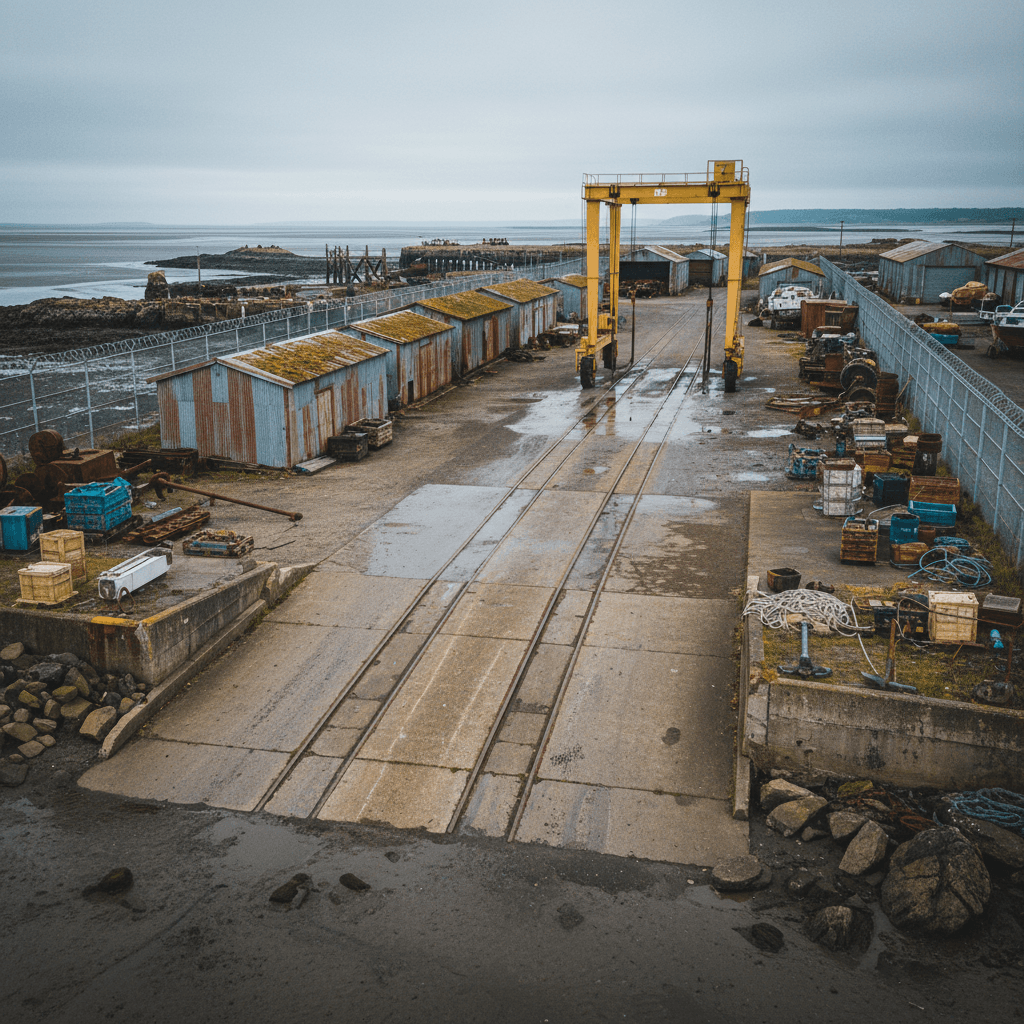
How Marina and Boat-Yard Properties End Up at Tax Deed Auctions
Marina dry-storage facilities and boat yards fall delinquent on property taxes for the same fundamental reasons any commercial property does — business failure, owner death, partnership disputes, or cost structures that outpace revenue. What makes them distinct is the gap between assessed value and functional value. A county assessor may value the land and improvements without fully accounting for the web of permits, licenses, and easements that actually make the facility operate. When a bidder pays top dollar at auction based on assessed value and then discovers the operating permits did not survive, the financial logic collapses.
Another factor is the capital intensity of these businesses. Boat-storage racking systems, travel lifts, haul-out equipment, marine railways, and fuel systems all require ongoing maintenance investment that cash-strapped owners defer. By the time a property reaches a tax deed auction, deferred maintenance may have accumulated for years, and that deferred maintenance can include conditions that trigger environmental review.
- Business insolvency often coincides with deferred maintenance that creates environmental exposure
- Assessed value can significantly overstate functional value when permits are non-transferable
- Partnership or estate disputes often cause tax delinquency on otherwise viable facilities
Riparian Rights and Water-Access Permits: What You Might Not Own After the Sale
For any marina or boat yard with water frontage, the most critical due-diligence question is not the land — it is the water. Riparian rights, which govern the right to access and use an adjacent body of water, are governed by a combination of state law, common law, and federal regulation, and the rules differ materially from one state to the next. In some jurisdictions, riparian rights attach to ownership of the upland parcel and convey with the deed. In others, water-access rights are separately documented, subject to state agency approval, or tied to operating permits that must be independently maintained.
Dock permits and pier permits issued by state environmental agencies, the Army Corps of Engineers, or local harbor authorities are typically tied to the applicant — not to the land. That means the permit does not automatically transfer to a new owner. After a tax deed auction, the new owner may need to apply for a fresh permit, and that application can take many months, involve public comment periods, and may be denied if the facility does not meet current environmental standards that were grandfathered for the prior operator.
Navigable waterways add another layer. If the water adjacent to the facility is classified as navigable, public-trust doctrine may limit what you can restrict or charge for access, and any expansion of docking or storage would require federal permits in addition to state approvals.
- Confirm whether riparian rights attach to the parcel deed or require separate licensing under state law
- Check Army Corps of Engineers Section 10 and Section 404 permits — these are issued to operators, not properties
- Research whether the facility operates under a state-issued submerged-land lease, which may be cancelable upon change of ownership
- Identify any public-trust obligations that limit the owner's ability to restrict water access
Environmental Liability: Fuel Systems, Bottom Paint, and Stormwater
Boat yards and marinas generate a specific environmental footprint that is well-documented in regulatory literature: bilge water and fuel releases, antifouling paint (which historically contained tributyltin and continues to use copper-based compounds), solvents used in boat repair, hydraulic fluid from travel lifts, and stormwater runoff carrying all of the above. Many older facilities operated under less stringent environmental standards for decades, and contamination may exist in soil, concrete pads, and waterway sediments.
An environmental Phase I assessment is a minimum starting point before bidding. If that assessment identifies recognized environmental conditions (RECs), a Phase II with actual soil and water testing becomes necessary. At a tax deed auction, you will almost never have the ability to conduct a Phase II before the sale closes. That gap between what you can discover and what may be present is a core risk of this asset class.
Federal and state environmental agencies can hold a property owner — including a new owner who acquired title at auction — liable for cleanup costs under CERCLA and state equivalent statutes. The innocent-purchaser defense under CERCLA requires that you conducted all appropriate inquiries before acquisition, which is a formal process, not simply browsing the auction catalog. If the prior operator had a Notice of Violation or consent order with an environmental agency, that obligation may follow the property regardless of how you acquired it.
Fuel systems deserve special attention. Underground storage tanks for marine diesel and gasoline are regulated under EPA rules similar to those governing gas stations. Any USTs on the property should be identified, their regulatory status confirmed, and any leaks or releases checked in state environmental databases before you commit a single dollar.
- Order a Phase I Environmental Site Assessment; treat any RECs as a potential deal-killer until scoped
- Search EPA ECHO, state environmental databases, and county records for NOVs, consent orders, or open enforcement actions
- Identify any underground storage tanks and check their compliance status with state UST program records
- Review stormwater permit (NPDES) status — a lapsed permit can result in immediate enforcement action upon transfer
Equipment Liens, Fixture Financing, and What the Deed Does Not Include
Travel lifts, marine railways, forklifts, dry-storage racking systems, and boat-yard cranes can be worth hundreds of thousands of dollars — but they may not be yours after the tax deed sale. Equipment that was financed separately and perfected as personal property collateral under UCC filings does not automatically become part of the real estate simply because it sits on the parcel. A secured lender whose UCC lien was properly recorded can repossess that equipment after the sale, leaving you with an empty concrete pad and a facility that cannot operate.
The line between fixtures (which pass with real property) and equipment (which does not) is determined by state law and the specific facts of installation. A travel lift bolted to a concrete foundation with custom attachment points is more likely to be treated as a fixture than a forklift stored in a building. But courts have gone both ways, and you should not rely on assumptions. Before bidding, search UCC filings in the state's central registry and in the county recorder's office for filings against the property address or the prior owner's business entity.
Operating agreements and slip rental agreements with boat owners may also survive the sale as enforceable leases, depending on state law and the lease terms. Those agreements could include below-market rates, long terms, or provisions that limit your ability to change the business model without triggering breach-of-contract exposure.
- Search UCC financing statements for equipment liens against the prior operator's business entity
- Identify all major equipment and assess whether each piece is likely a fixture or personal property
- Review any existing slip or storage rental agreements for terms that bind a successor owner
- Check for vendor or contractor liens on equipment maintenance or installation contracts
Zoning, Conditional Use Permits, and Business Continuity Risk
Marine industrial or commercial-waterfront zoning is among the most restricted land-use categories in many jurisdictions. Local governments, often under pressure to convert working waterfronts to residential or recreational uses, have enacted zoning overlays and maritime industrial protection districts with highly specific use requirements. The existing boat-yard or dry-storage use may be legally nonconforming — meaning it was established before current zoning rules and is permitted to continue only as long as the use is not abandoned.
Tax delinquency and business closure often trigger an abandonment clock under local zoning codes. If the property has been vacant or non-operational for a defined period — commonly six to twelve months — the nonconforming use may be deemed abandoned, and you would need to apply for a new conditional use permit to restart operations. That application process can take a year or more, involve public hearings, and may face opposition from neighboring residential or environmental stakeholders.
Even if the nonconforming use is still active at the time of auction, verify that the specific activities you intend to conduct — dry storage, wet slips, haul-out services, marine repair, fuel sales — are each individually permitted, because a conditional use permit may authorize some but not all of these uses.
A tool like TaxDeedIQ can flag zoning status and surface known risk layers on a parcel before you bid, giving you a structured starting point for deeper county-level and legal verification. That kind of pre-bid risk framework is especially important for complex commercial waterfront properties where the layers compound quickly.
- Confirm the current zoning classification and whether the existing use is conforming or legally nonconforming
- Check for abandonment provisions in the local zoning ordinance and calculate how long the property has been inactive
- Identify all activities covered by existing conditional use permits and what a new owner would need to re-apply for
- Consult with a local land-use attorney before bidding on any property where nonconforming-use status is a material factor
Score every auction before you bid
TaxDeedIQ gives every US tax deed & tax lien auction a 0–100 safety score, surviving liens, IRS redemption, flood, homestead.
Start my free trialMarina Dry-Storage Facilities and Boat Yards at Tax Deed Auctions FAQ
Do dock permits and water-access permits transfer automatically when I buy a marina at a tax deed auction?
Generally, no. Dock permits issued by state environmental agencies or the Army Corps of Engineers are typically tied to the permit holder — meaning the prior operator — rather than to the land itself. After a tax deed purchase, you will likely need to apply for new permits in your name, a process that can take months and may require meeting current environmental standards that the prior operator was grandfathered out of. Confirm the permit transfer rules with the specific issuing agency before you bid.
Can I be held liable for environmental contamination at a boat yard even if I just bought it at a tax deed auction?
Potentially yes. Federal law under CERCLA and many state environmental statutes allow regulators to pursue cleanup costs from current property owners regardless of when the contamination occurred or who caused it. The innocent-purchaser defense requires proof of all appropriate inquiries conducted before acquisition — a formal standard, not just casual research. At a minimum, commission a Phase I Environmental Site Assessment before bidding, and treat any recognized environmental conditions as a material risk that must be priced into your offer or cause you to pass entirely.
What happens to the dry-storage racking and travel lift equipment after a tax deed sale?
It depends on how the equipment was financed and whether it legally qualifies as a fixture or as personal property under your state's law. Equipment financed through UCC-secured loans and not legally classified as a fixture can be repossessed by the lienholder after the sale — the tax deed does not extinguish those security interests. Search UCC filings in the state central registry and county records before bidding to identify any perfected equipment liens, and consult with a real estate attorney to assess which items are likely to be treated as fixtures versus personal property.
How does legally nonconforming use status affect a boat yard or marina I buy at auction?
A legally nonconforming use is one that pre-dates current zoning restrictions and is allowed to continue only under specific conditions — typically that the use not be abandoned or significantly changed. If the property has been inactive for a period that triggers the local abandonment definition (often six to twelve months), the nonconforming status may be lost, requiring you to seek a new conditional use permit to operate. That process can be lengthy, uncertain, and expensive. Always verify current zoning status and abandonment clock status directly with the local planning or zoning department before bidding.
More guides
- Tax Deed vs Tax Lien: What's the Difference? (2026 Guide)
- Is Tax Deed Investing Safe? 6 Risks to Check Before You Bid
- Tax Deed Surplus Funds: How Overbid Recovery Works
- Redeemable Deed States Explained (Georgia, Texas & More)
- Tattoo Parlors and Body Art Studios at Tax Deed Auctions: Health Code Liability, Equipment Liens, and the Risks Every Investor Must Evaluate Before Bidding
- Vehicle Auction Lots and Used Car Dealerships at Tax Deed Auctions: Floor Plan Liens, Franchise Termination, and the Risks Every Investor Must Evaluate Before Bidding
Informational only, not legal or investment advice. Confirm rules with the county and consult a licensed professional before bidding.